
When ‘Editable’ isn’t usable
UX Audit
Enterprise UX

Context.
Hailey is an internal application at Coolblue used by customer journey specialists to manage transactional email communications across multiple customer journeys.
It was introduced to reduce reliance on development teams, enabling non-technical users to independently create and maintain high-volume, business-critical email templates.
Key constraints:
- Legacy architecture
- Strong developer ownership of the UI
- Limited appetite for visual change
- High cost of errors in production emails
- No immediate mandate for redesign
These constraints shaped both the scope of the audit and the way recommendations were framed.
The Challenge: Realigning a Developer-Centric System to a New User Reality
As ownership shifted from developers to customer journey and marketing specialists, Hailey’s developer-centric interaction model no longer aligned with its primary users.
Tasks that were once manageable for technical users introduced unnecessary cognitive load for non-technical specialists, increasing the risk of errors in everyday workflows.
The challenge was not just identifying usability issues, but persuading a team deeply invested in the existing interface that the system’s assumptions about its users had fundamentally changed.
Approach.
Using a UX Audit as a Persuasion Tool
Given the system’s legacy nature and resistance to large-scale UI changes, a full redesign proposal would have been premature and unlikely to succeed.
Instead, I focused the audit on Hailey’s core value driver: the email template editing workflow.
My approach combined:
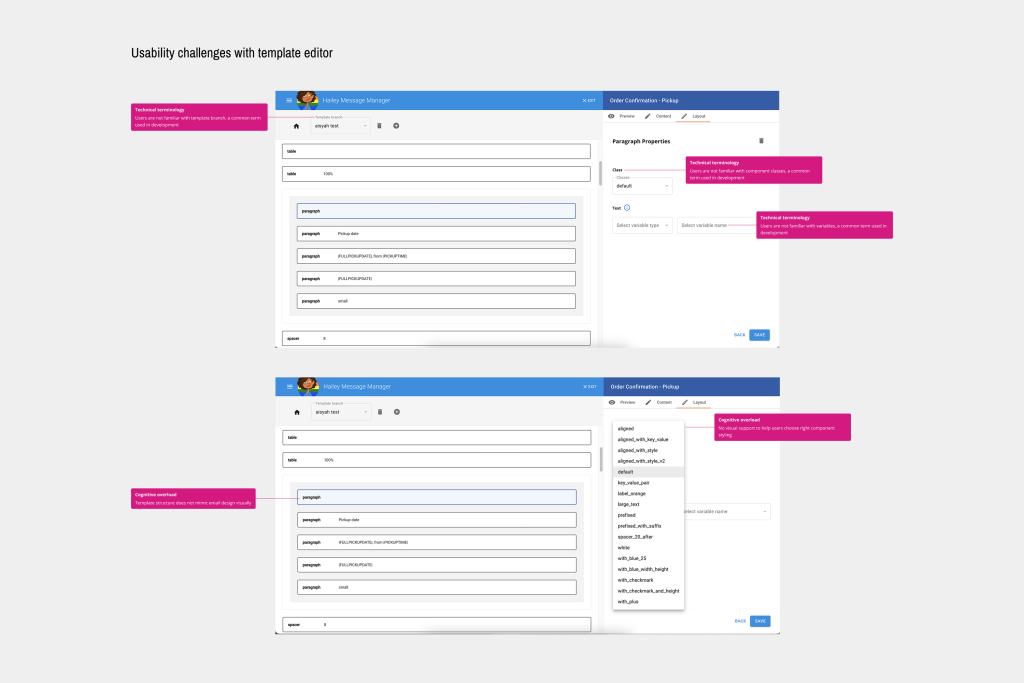
1. A task-based UX audit of the template editing flow and mapping key screens involved in template editing
2. A moderated user session to validate assumptions and evaluate whether users understood the purpose and functionality of each screen without external help
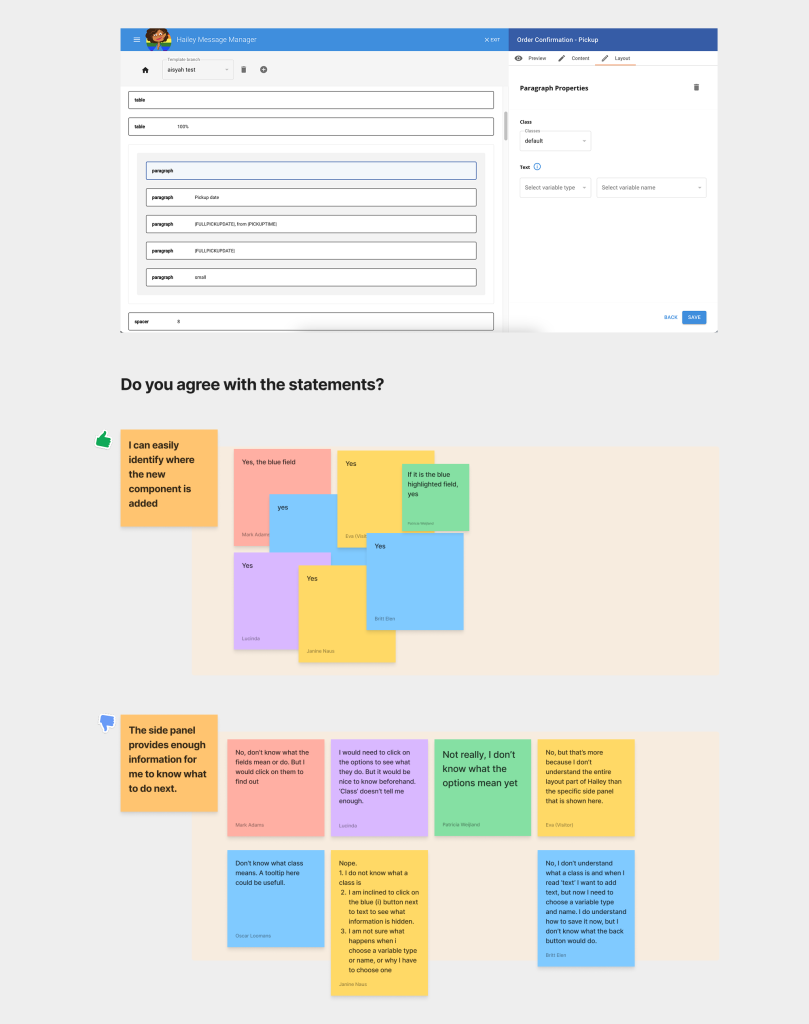
This allowed me to contrast the system’s technical structure with users’ mental models and surface where friction translated into real operational risk.
Key Findings
- Low adoption of the template editor, with only 2 out of 10 intended users actively using the feature
- High cognitive load, driven by limited experience with template editors and a lack of in-context guidance
- Technical terminology such as “branches,” “variables,” and “component classes” created comprehension gaps, leading to hesitation, errors, and reliance on developer support
These issues made the tool feel fragile and intimidating, particularly in high-stakes scenarios where accuracy and confidence were critical.
Recommendations
Incremental, System-Aware Improvements
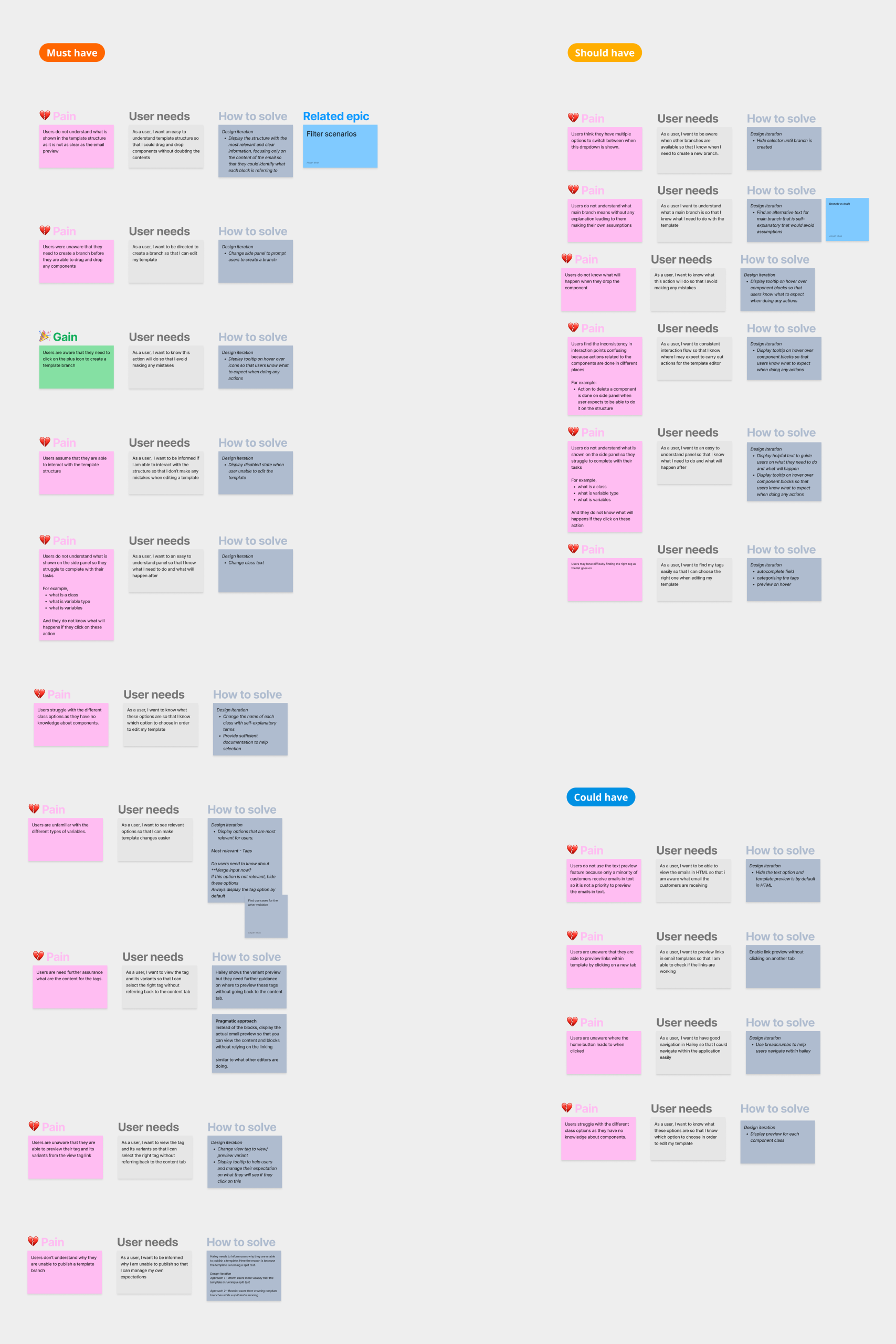
Rather than advocating for a complete overhaul, I framed recommendations as incremental, low-risk improvements aligned with both usability impact and technical feasibility.
Using a MoSCoW prioritization framework, recommendations focused on:
- Reducing exposure to technical terminology for non-technical users
- Introducing progressive disclosure and contextual guidance
- Improving error prevention in critical workflows
- Supporting confidence and clarity during template editing
This approach allowed the team to discuss usability improvements without immediately challenging the existing architecture.
Outcome.
The findings were shared with the product owner and development team, grounded in real user evidence rather than abstract heuristics.
This shifted conversations from defending the current interface to exploring how the system could better support its evolving user base. While no immediate redesign was mandated, the audit created shared awareness of usability risks and established a more collaborative foundation for future improvements.
What We Planned Next
Together with the product owner, we aligned on designing a scalable solution in the following quarter that addressed the highest-risk usability issues identified during the audit.
The goal was to reduce error risk in customer communications while laying the groundwork for a more user-centric evolution of the tool.
Key takeaways
- Meaningful UX change often starts with alignment, not artifacts
- Framing usability issues in terms of risk and operational impact builds cross-disciplinary trust
- Design influence does not always require high-fidelity solutions
- Establishing a shared vision was more valuable than proposing a polished redesign at this stage